

Blog
Seed Cycling for PCOS: Complete Guide for Pakistani Women (2026)

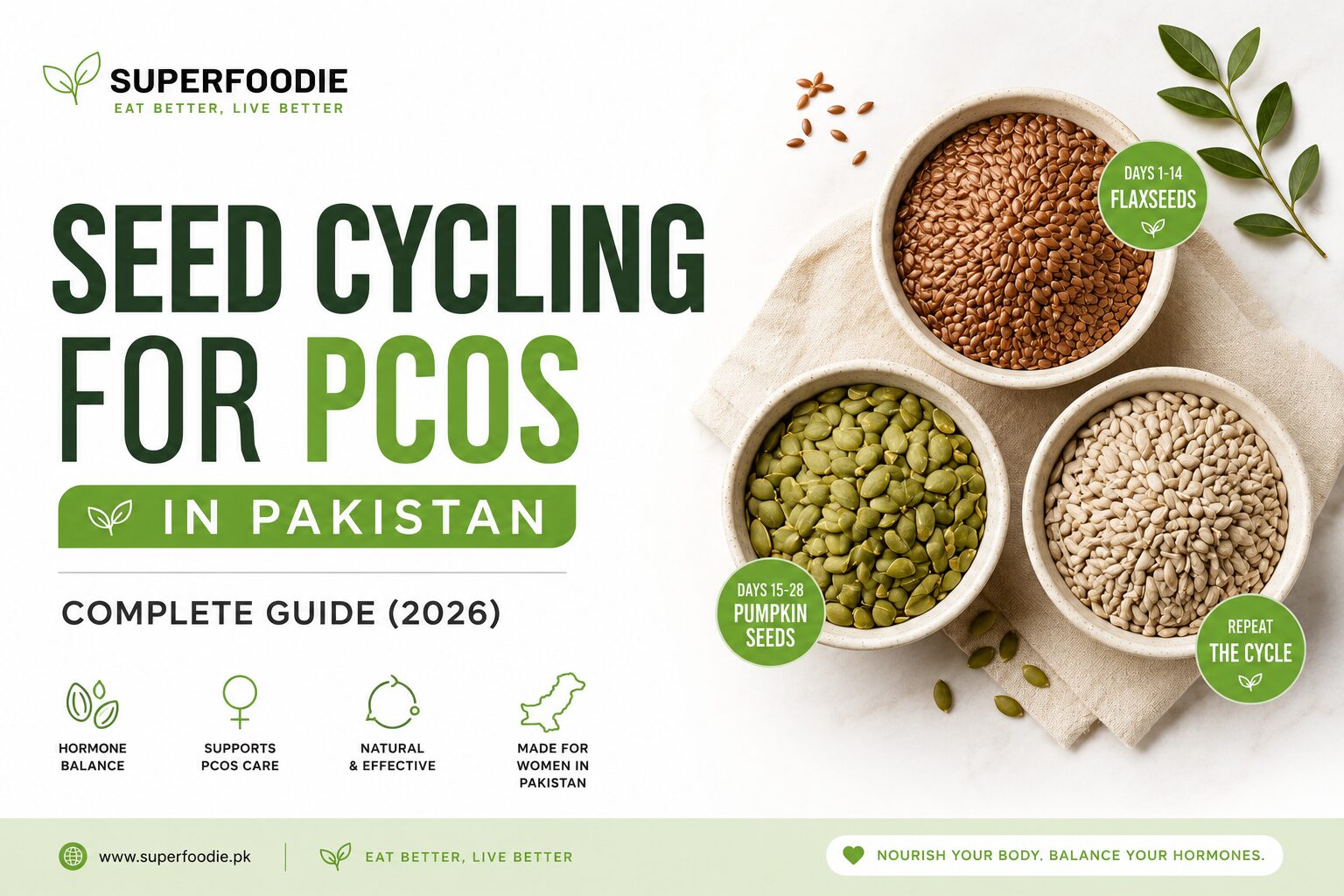
If you’ve been searching for natural ways to support your hormones alongside your PCOS management plan, you’ve probably come across “seed cycling.” It’s become a popular topic in wellness circles — but what does it actually involve, and does it hold up?
This guide breaks down what seed cycling is, the seeds involved, how the two-phase method works, and what it can realistically add to a PCOS routine.
What Is Seed Cycling?
Seed cycling is the practice of eating specific seeds during different phases of the menstrual cycle, timed to align with the body’s natural hormonal shifts. The idea originated in naturopathic and functional nutrition circles and has since become a mainstream wellness practice, especially among women managing PCOS, irregular cycles, or hormone-related symptoms.
The method uses four seeds — pumpkin, flax, sunflower, and sesame — split across two phases:
- Follicular phase (Day 1–14, from the start of your period): pumpkin seeds and flax seeds
- Luteal phase (Day 15–28, until your next period): sunflower seeds and sesame seeds
For women with PCOS, where cycles are often irregular or absent, the general recommendation is to follow the lunar cycle instead (roughly 14 days per phase) or restart the cycle with any bleeding.
Why These Specific Seeds?
Each seed brings a distinct nutritional profile that’s believed to support the hormonal environment of its phase:
Pumpkin seeds are rich in zinc, which plays a role in progesterone production, plus omega-3s and fiber.
Flax seeds contain lignans, plant compounds that may help the body metabolize excess estrogen — relevant for PCOS, where estrogen-androgen balance is often disrupted. Flax is also a strong source of fiber and omega-3 ALA.
Sunflower seeds provide vitamin E and selenium, both linked to healthy progesterone support during the luteal phase.
Sesame seeds contain lignans similar to flax, along with zinc and healthy fats, and are traditionally used to support the transition into the luteal phase.
It’s worth being clear-eyed here: the research on seed cycling specifically is still limited — most of the evidence is indirect, drawn from studies on the individual nutrients (zinc, lignans, selenium) rather than large clinical trials on seed cycling as a protocol. What we can say confidently is that these seeds are nutrient-dense, low-risk additions to a diet, and many women report subjective improvements in cycle regularity and PCOS symptoms over consistent use. Seed cycling works best as a complement to — not a replacement for — medical management of PCOS.
How to Do Seed Cycling: Step-by-Step
Follicular Phase (Day 1–14)
- 1 tablespoon each of ground pumpkin seeds and ground flax seeds daily
- Add to smoothies, yogurt, oatmeal, or salads
- Ground seeds absorb better than whole — grind fresh or use pre-ground
Luteal Phase (Day 15–28)
- 1 tablespoon each of ground sunflower seeds and ground sesame seeds daily
- Same method — smoothies, yogurt, or roasted and sprinkled over meals
- Continue until your period starts, then switch back to Phase 1
For irregular or absent cycles (common in PCOS): follow a 14-day/14-day split regardless of bleeding, and adjust based on your doctor’s or nutritionist’s guidance.
Simple Ways to Include Seeds in a Pakistani Diet
Seed cycling doesn’t require a diet overhaul — it fits naturally into everyday Pakistani meals:
- Sprinkle ground seeds over raita or chaat
- Mix into lassi or a morning smoothie
- Add to paratha dough or atta for baking
- Stir into daliya or oatmeal at breakfast
- Blend into chutneys or added post-cooking to salan
A Note on Consistency
Like most nutrition-based approaches, seed cycling is a slow-build strategy — most women who report noticing a difference have been consistent for at least 3 menstrual cycles (roughly 3 months) before evaluating results. Track your symptoms (cycle regularity, skin, mood, energy) in a simple notes app or journal so you can actually compare month to month rather than relying on memory.
FAQs
Is seed cycling scientifically proven to help PCOS? Direct clinical research on seed cycling as a whole protocol is limited. The individual nutrients involved (zinc, lignans, selenium, omega-3s) do have research support for hormonal health, which is why the practice is widely recommended in nutrition circles, but it should be seen as a supportive habit rather than a proven treatment.
Can I do seed cycling if my periods are irregular? Yes — this is actually one of the more common reasons women with PCOS try it. Follow a fixed 14-day/14-day cycle instead of tracking bleeding, and adjust with guidance from your doctor.
How long before I notice a difference? Most women who track results give it a minimum of 3 cycles (about 3 months) of consistent daily use before evaluating.
Do the seeds need to be raw or roasted? Both work — raw ground seeds are the most commonly recommended for nutrient retention, but lightly roasted seeds are fine too and often easier to incorporate into Pakistani dishes.
Can seed cycling replace my PCOS medication? No. Seed cycling is a dietary practice that may support hormonal balance alongside medical care — it isn’t a substitute for medication, diagnosis, or treatment prescribed by your doctor. If you have PCOS, continue working with your physician and use this as a complementary habit.
Make It Easy: Superfoodie’s PCOS Seed Cycling Kit
Sourcing and grinding four separate seeds every two weeks is where most people give up on seed cycling. Our PCOS Seed Cycling Kit takes that friction away — pre-portioned pumpkin, flax, sunflower, and sesame seeds, sourced and packed fresh, so you just follow the phase and go.
👉 Order the PCOS Seed Cycling Kit via our website or WhatsApp us directly at +92 318 8129288 for COD across Pakistan.
Written by Khan, Founder of Superfoodie.pk — Feed The Grind.