

Blog
Seed Cycling for PCOS: Does It Actually Work?

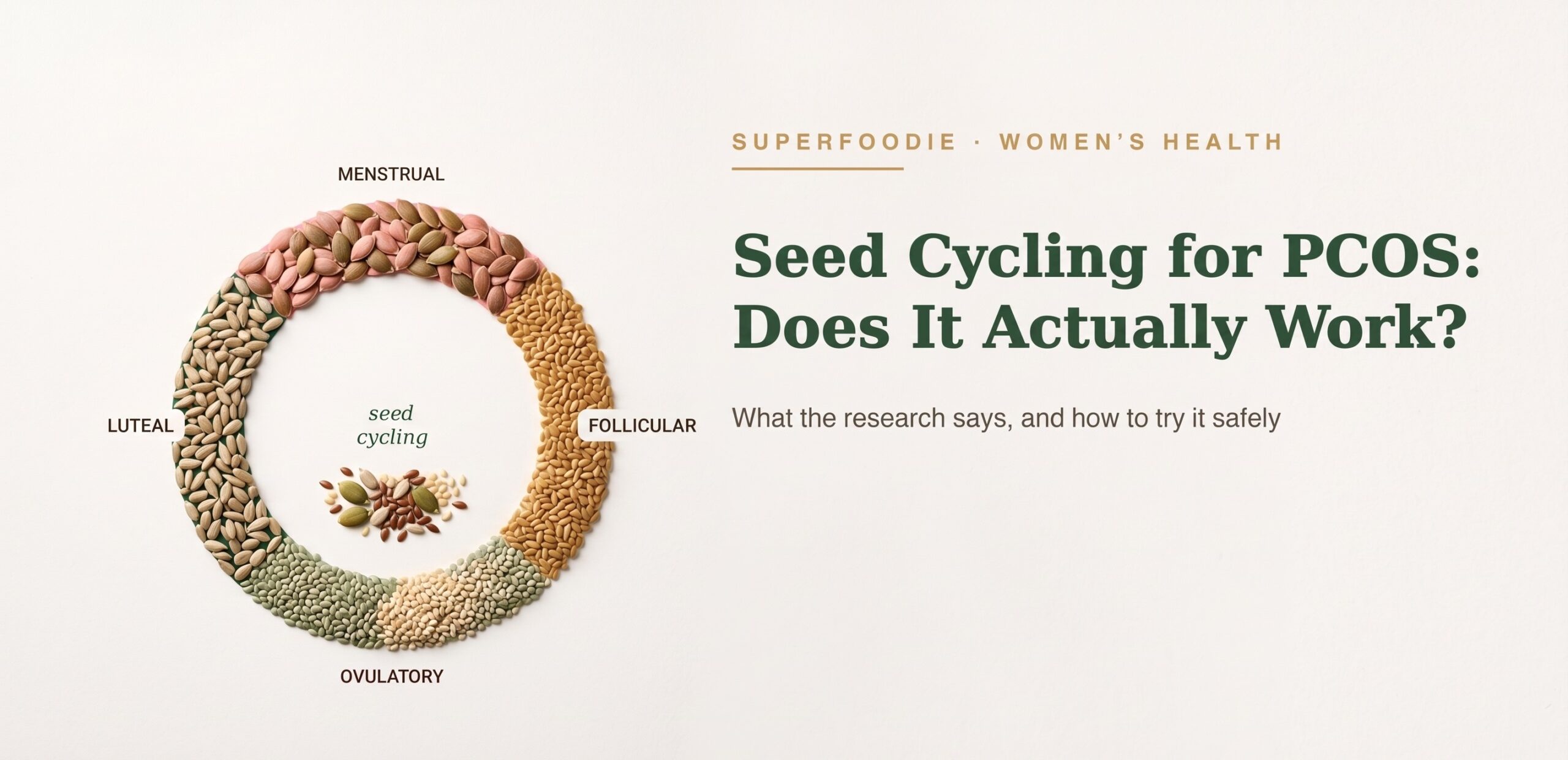
Seed cycling — eating specific seeds during specific phases of your menstrual cycle — has become one of the most searched natural approaches to PCOS and hormonal balance. The honest answer on whether it “works”: there’s a real nutritional rationale behind it, but there isn’t large-scale clinical research on seed cycling as a practice itself. Here’s what’s actually known, and how to think about it.
This article is general nutrition information, not medical advice. PCOS is a diagnosed medical condition — seed cycling is a dietary addition to discuss with your doctor, not a replacement for medical management.
What Seed Cycling Actually Is
The practice splits your cycle into two nutritional halves:
- Follicular phase (roughly days 1–14): 1–2 tablespoons each of raw, ground pumpkin seeds and flax seeds daily.
- Luteal phase (roughly days 15–28): 1–2 tablespoons each of raw, ground sunflower seeds and sesame seeds daily.
The idea is that different phases of the cycle are dominated by different hormones — estrogen rising through the follicular phase, progesterone rising through the luteal phase — and each seed pair supplies nutrients theoretically supportive of that phase.
The Nutritional Theory Behind It
| Seed | Phase | Relevant Nutrients | Proposed Role |
|---|---|---|---|
| Pumpkin seeds | Follicular | Zinc | Zinc supports normal reproductive hormone production |
| Flax seeds | Follicular | Lignans, omega-3 (ALA) | Lignans are thought to help regulate estrogen metabolism |
| Sunflower seeds | Luteal | Selenium, vitamin E | Selenium supports thyroid function, which interacts with reproductive hormones |
| Sesame seeds | Luteal | Lignans, zinc | Similar lignan-based rationale as flax, timed to the progesterone-dominant phase |
All four of these nutrient-hormone relationships are individually documented in nutrition research. What hasn’t been specifically tested in large clinical trials is whether cycling them in this exact two-phase pattern produces a measurable hormonal effect beyond what a generally seed-inclusive diet would provide. Most of what’s written about seed cycling online is based on functional-medicine practice and anecdotal reporting, not peer-reviewed trials of the protocol itself.
Why It’s Still Worth Trying for Many Women
- Low risk. These are whole foods already recommended for general health — there’s no meaningful downside to eating them, cycled or not, barring seed allergies.
- Nutrient-dense regardless. Even if the phase-timing effect is unproven, all four seeds are good sources of fiber, healthy fats, zinc, and lignans that support metabolic and hormonal health generally — which matters directly for PCOS, where insulin resistance is often central.
- A structure that builds a habit. For many women, the main benefit is that “seed cycling” gives a simple, trackable structure that gets them eating a wider variety of seeds daily — something most diets in Pakistan don’t otherwise include much of.
What Seed Cycling Won’t Do
It won’t replace medical management of PCOS — metformin or other prescribed medication where indicated, addressing insulin resistance, managing weight where relevant, and regular monitoring with a gynecologist or endocrinologist all remain the actual clinical management of the condition. Seed cycling is reasonably framed as a supportive dietary habit alongside that care, not instead of it.
How to Start Seed Cycling Safely
- Use raw, unroasted seeds — ground fresh (a coffee grinder works) improves absorption of the fats and lignans.
- Track your cycle to know which phase you’re in — day 1 is the first day of your period.
- If your cycle is irregular (common with PCOS), a simple rule some women use is a straight 14-day/14-day split rather than trying to track ovulation precisely.
- Introduce one new seed at a time if you haven’t eaten these regularly before, to rule out any digestive sensitivity.
- Keep seeds fresh — see our Seeds & Moringa Powder Price in Pakistan guide for what to check when buying, since stale seeds lose potency faster than most people expect.
Where Superfoodie Fits
Our PCOS Seed Cycling Kit is pre-portioned into follicular and luteal packs — pumpkin and flax together, sunflower and sesame together — so you’re not buying and measuring four separate bags. See our Seed Cycling Kit price breakdown for how it compares to buying each seed separately.
FAQs: Seed Cycling for PCOS
Does seed cycling cure PCOS?
No. Seed cycling is a supportive dietary practice, not a treatment for PCOS. Medical management with a doctor remains the primary approach; seed cycling is something to discuss adding alongside it.
Is there scientific proof that seed cycling works?
The individual nutrients involved (zinc, lignans, selenium, vitamin E) have documented roles in hormone metabolism, but there isn’t large-scale clinical research testing the seed cycling protocol itself as a treatment for PCOS or hormonal imbalance.
How long before you’d notice anything from seed cycling?
Most anecdotal reports suggest trying it consistently for at least 3 menstrual cycles before evaluating whether it’s made a noticeable difference, since hormonal patterns take time to shift and are influenced by many factors beyond diet.
Can seed cycling be done with an irregular cycle?
Yes — a common approach for irregular cycles is a straight 14-day/14-day split rather than trying to track ovulation exactly, since consistency matters more than precise timing.