

Blog
Corporate Wellness Gifts in Pakistan: What HR Teams Are Actually Buying in 2026

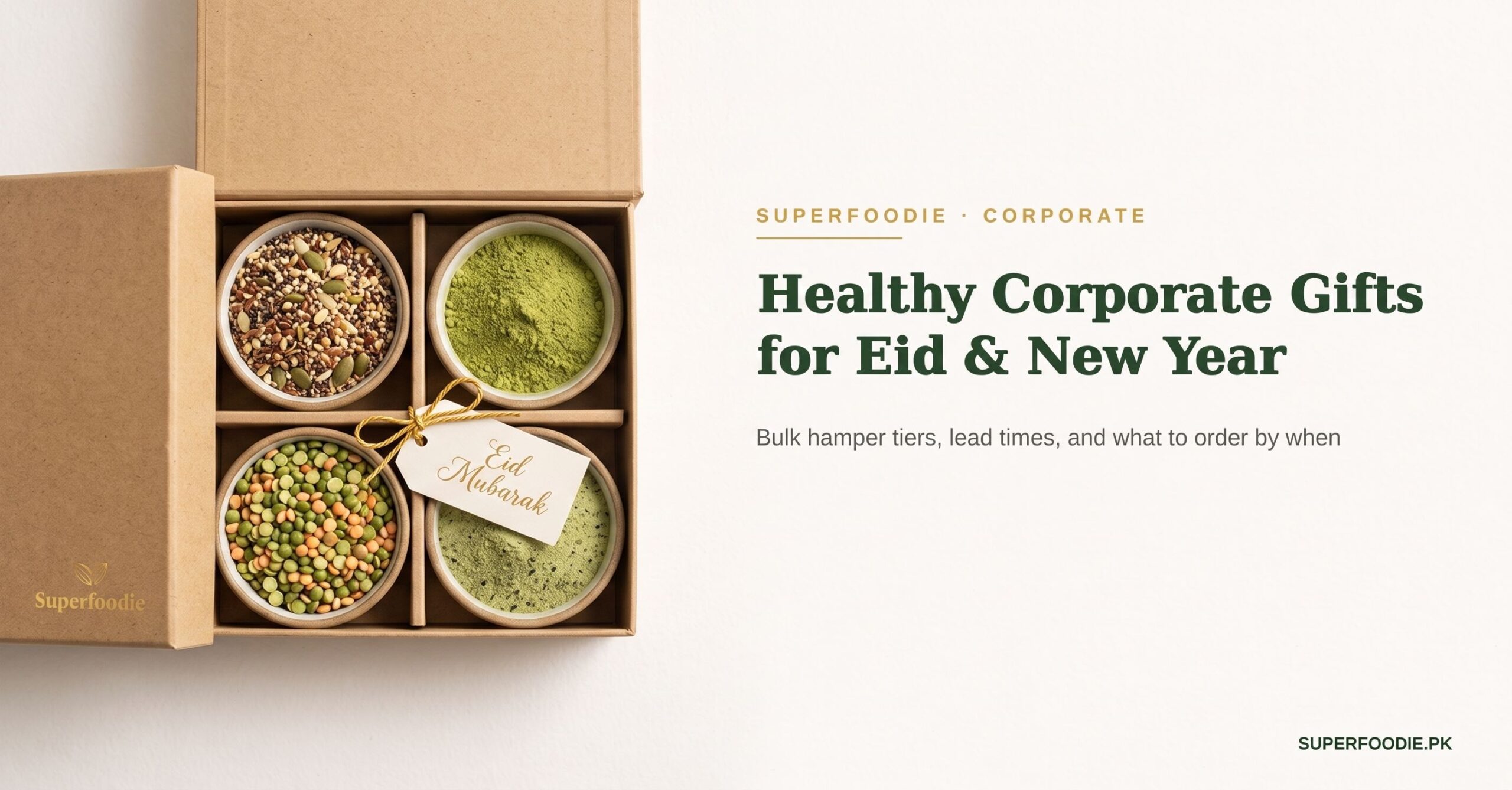
The generic gift basket — dry cake, some biscuits, maybe a scented candle — is losing ground fast in corporate gifting. HR and admin teams at banks, tech companies, and pharma firms are shifting budget toward wellness-positioned gifts that look intentional rather than obligatory. Here’s what’s actually driving those purchase decisions, and how to buy it without a six-week back-and-forth.
Why the Shift Toward Wellness Gifting
- Perceived value per rupee is higher. A well-presented seeds/nuts hamper reads as more premium than an equivalently priced sweets box, and photographs better for internal comms/LinkedIn posts HR teams increasingly care about.
- Dietary inclusivity. Sweets and baked goods exclude diabetic employees, those avoiding sugar, and increasingly health-conscious younger staff. Seeds, nuts, and dried fruit hampers work across almost every dietary preference in one SKU.
- Shelf life. Perishable gifts (cakes, fresh fruit baskets) create a logistics problem for large distributions — 200 employees receiving a cake on the same afternoon is a delivery-timing nightmare. Shelf-stable wellness products remove that constraint entirely.
Budget Tiers: What Companies Actually Spend Per Head
| Tier | Typical Spend Per Employee | What’s Usually Included |
|---|---|---|
| Economy | Rs. 800 – 1,500 | Single seed/nut product, simple branded packaging |
| Standard | Rs. 1,500 – 3,000 | 2–3 product hamper (seeds, dried fruit, moringa/herbal tea), branded box |
| Premium | Rs. 3,000 – 6,000+ | Full hamper with custom branding, premium packaging, sometimes a personalized card or company-branded ribbon |
Most mid-size Pakistani companies (100–500 employees) land in the Standard tier for annual gifting (Eid, year-end) and Economy tier for smaller, more frequent touches (onboarding kits, wellness-month giveaways).
What HR/Procurement Actually Cares About (Beyond Price)
- Minimum order quantity (MOQ) and whether it scales. A supplier who can only comfortably do 50 units isn’t useful to a 400-person distribution — ask upfront what their comfortable bulk range is, not just their listed MOQ.
- Lead time, stated honestly. “2 weeks” that’s actually 3 weeks under real order volume is the single most common procurement complaint with gift suppliers. Ask for the lead time under their busiest season (Eid, year-end), not their average.
- Invoicing and payment terms. Corporate buyers need a proper invoice, often with advance/balance payment terms — COD-only suppliers (common in D2C) frequently aren’t set up for this and it becomes a blocker mid-negotiation.
- Branding options. Custom labels, company logo on the box, or a branded ribbon are usually the deciding factor between two similarly priced suppliers — confirm whether this is included or a separate cost before comparing quotes.
- Sample availability. Any supplier unwilling to send a single sample hamper before a 200+ unit order is a red flag, not a minor inconvenience.
A Procurement Checklist (Save or Forward This)
- ☐ Confirmed per-unit price at your actual order volume (not the smallest listed tier)
- ☐ Lead time confirmed for your specific delivery date, factoring in peak season
- ☐ Sample requested and approved before full order placed
- ☐ Branding/customization cost confirmed as included or itemized separately
- ☐ Invoice and payment terms confirmed (advance %, balance timing)
- ☐ Delivery logistics confirmed — single office vs. multiple branch delivery, and any additional cost for the latter
Where Superfoodie Fits
Our FEED THE GRIND™ Corporate Wellness Box is built around three tiers matching the budget ranges above, using raw, sortex-cleaned seeds and moringa rather than roasted snack-aisle products. For Eid and New Year-specific bulk hamper options and lead times, see our Healthy Corporate Gift Ideas for Eid / New Year guide. For bulk pricing, samples, and lead times for your team size, reach out directly — see the Corporate Wellness Box page.
FAQs: Corporate Wellness Gifting in Pakistan
How much do companies typically spend per employee on wellness gifts?
Most mid-size companies spend Rs. 1,500–3,000 per employee for standard annual gifting (Eid, year-end), with Rs. 800–1,500 common for smaller, more frequent touches like onboarding kits.
What should I ask a corporate gift supplier before placing a bulk order?
Confirm their lead time under peak-season order volume (not their average), whether branding/customization is included in the price, their invoicing and payment terms, and whether they’ll provide a sample before the full order.
Why are companies moving away from traditional sweet hampers?
Mainly dietary inclusivity (sweets exclude diabetic and health-conscious employees), shelf life for large-scale distribution, and perceived value — wellness-positioned gifts often read as more premium at a similar price point.