Blog
Moringa Powder Benefits in Pakistan: Nutrition, Uses, How to Take It & What Science Says

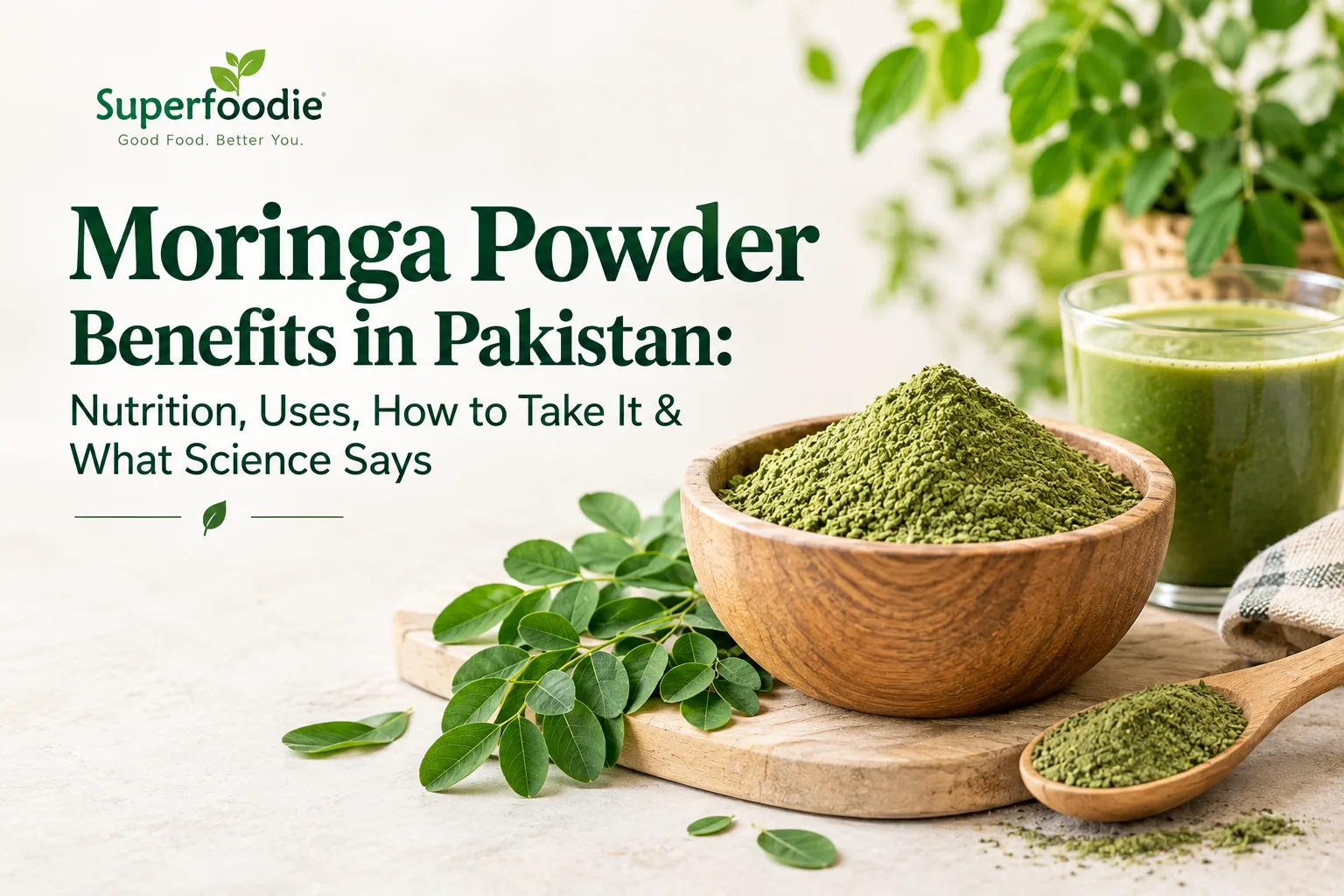
Moringa has been part of South Asian food and traditional practices for generations. In Pakistan, the tree is commonly known as Sohanjna (سوہانجنا) or Sohanjana, while its dried leaf powder is usually sold as Moringa Powder or Sohanjna Powder.
Today, moringa powder is increasingly used as an everyday food ingredient because moringa leaves contain protein, vitamins, minerals, polyphenols and other plant compounds. Recent reviews describe Moringa oleifera leaves as nutritionally valuable and rich in bioactive compounds. (PubMed)
But there is a lot of confusion about what moringa can actually do.
Some websites call it a “miracle powder” that can cure diabetes, melt fat, detox the body, balance hormones, prevent cancer and solve almost every health problem.
The scientific evidence is much more nuanced.
Moringa can be a nutrient-rich addition to a balanced diet, but it should not be treated as a cure or replacement for medical treatment.
This guide explains moringa powder benefits, nutrition, uses, dosage, how to take it, weight-loss claims, blood-sugar research, possible side effects and what to look for when buying moringa powder in Pakistan.
What Is Moringa?
Moringa comes from the tree Moringa oleifera, a plant native to South Asia that is now cultivated widely in tropical and subtropical regions.
Different parts of the plant can be used, including:
- Leaves
- Pods
- Seeds
- Flowers
- Roots
For everyday nutrition, moringa leaf powder is the form most commonly used as a food ingredient.
The leaves contain a mixture of protein, minerals, vitamins, fiber and plant phytochemicals, although the exact nutritional composition varies with growing conditions, processing and the form of moringa used. A 2025 comprehensive review described Moringa leaves as containing vitamins, minerals, antioxidants and other bioactive compounds. (PubMed)
What Is Moringa Called in Pakistan?
In Pakistan, moringa is commonly known as:
Sohanjna — سوہانجنا
You may also see:
Sohanjana — سوہانجنا
Sohanjna powder
Moringa powder
Moringa leaf powder
Moringa oleifera
If you’re searching online, “moringa powder Pakistan”, “sohanjna powder” and “sohanjna benefits” can all refer to products made from the dried leaves of Moringa oleifera.
One important point when buying:
Make sure you’re buying leaf powder if your intention is everyday nutrition.
Moringa leaves, seeds, roots, bark and extracts are not interchangeable. Their chemical composition and safety profiles can differ substantially.
Moringa Powder Nutrition
Moringa leaf powder is often described as a nutrient-dense food because dried leaves concentrate many of the nutrients naturally present in fresh leaves.
Reviews of Moringa oleifera report the presence of:
- Plant protein
- Dietary fiber
- Calcium
- Potassium
- Iron
- Magnesium
- Vitamins
- Carotenoids
- Polyphenols
- Flavonoids and other phytochemicals
The actual amount in a spoonful of powder depends on the source, drying method, maturity of the leaves and processing technique, so nutrition numbers should be taken from the specific product’s laboratory or nutrition information rather than assuming every moringa powder is nutritionally identical.
That variation is one reason product quality matters.
8 Potential Benefits of Moringa Powder
1. Moringa Can Help Increase Nutrient Variety
One of the simplest reasons to use moringa powder is to add another nutrient-dense plant food to your diet.
Moringa leaves contain several micronutrients and bioactive plant compounds, making the powder a convenient way to incorporate some of the nutritional components of the leaves without having to prepare fresh leaves.
Think of it as:
an ingredient that adds nutritional variety
rather than:
a medicine that treats everything.
2. Moringa Provides Plant Protein
Moringa leaves contain protein, including essential amino acids, and dried leaf powder is more concentrated than fresh leaves because water has been removed.
However, the amount of moringa powder normally consumed is relatively small.
That means moringa is better considered a protein-containing food ingredient rather than your primary protein source.
For example, your overall diet might contain:
Eggs + yogurt + lentils + chicken/fish + seeds + vegetables
with a small amount of moringa powder added for variety.
3. Moringa Provides Minerals
Moringa leaves contain several minerals including calcium, potassium, iron and magnesium.
This makes moringa an interesting addition to diets that contain a wide variety of plant foods.
But don’t make the common mistake of assuming:
“Moringa contains iron, therefore moringa cures anemia.”
That’s not how nutrition works.
Whether someone has an iron deficiency depends on total dietary intake, absorption, losses, medical conditions and other factors.
Moringa can contribute nutrients; it should not replace proper evaluation or prescribed iron treatment when deficiency is diagnosed.
4. Moringa Contains Antioxidant Plant Compounds
Moringa leaves contain polyphenols, flavonoids and other phytochemicals that show antioxidant activity in laboratory research.
Antioxidants are a normal part of the body’s biological systems, but this does not mean that drinking moringa powder automatically “detoxes” the body.
Your liver, kidneys, lungs and other systems already handle waste and metabolism.
So:
Moringa contains antioxidant compounds.
But:
“Moringa detoxes your body” is an oversimplified marketing claim.
5. Moringa and Blood Sugar: What Does the Evidence Say?
This is one of the most interesting—and most frequently exaggerated—moringa topics.
Some human studies have reported improvements in glucose-related markers after moringa supplementation.
A 2026 systematic review and meta-analysis included 20 clinical studies involving people with metabolic diseases and found associations between Moringa oleifera supplementation and lower fasting blood glucose, HbA1c and blood pressure. However, the authors emphasized heterogeneity and limitations in study quality and described the findings as preliminary and hypothesis-generating.
Another 2025 meta-analysis focusing on randomized controlled trials found no significant effects on most cardiometabolic outcomes overall. A modest reduction in diastolic blood pressure was observed, but it was not robust in sensitivity analysis, and the certainty of evidence was rated very low.
What should you take from this?
Moringa is scientifically interesting.
But the evidence is not strong enough to say moringa powder treats diabetes.
If you have diabetes or prediabetes, don’t replace prescribed treatment with moringa.
6. Moringa and Blood Pressure
The same evidence applies to blood pressure.
Some clinical studies report possible improvements, and the 2026 meta-analysis found reductions in blood pressure among people with metabolic diseases. But the researchers cautioned that the studies were heterogeneous and had limitations, meaning stronger trials are still needed. (PubMed)
The 2025 randomized-trial meta-analysis was even more cautious and found that the overall evidence for consistent cardiometabolic benefits was very low-certainty.
Therefore:
Moringa can be part of a healthy diet. It is not a substitute for blood-pressure medicine.
7. Moringa May Support a Nutrient-Rich Diet During Periods of Increased Nutritional Need
Moringa leaves have been studied in contexts involving maternal nutrition, lactation and nutritional status.
A 2026 NCBI LactMed review notes that moringa leaves contain vitamins, minerals and essential amino acids, and summarizes research suggesting possible effects on milk production. However, long-term infant outcomes remain insufficiently studied, and the database emphasizes that galactagogues should not replace evaluation of the underlying reasons for low milk supply. (NCBI LactMed)
This means you should not market moringa as a guaranteed breastfeeding treatment.
For pregnancy and breastfeeding, individual medical advice is preferable because products, doses and circumstances vary.
8. Moringa Is an Easy Way to Add a Green Plant Ingredient to Everyday Meals
Sometimes convenience is the biggest benefit.
Moringa powder can be mixed into:
- Smoothies
- Yogurt
- Lassi
- Oats
- Soups
- Daal
- Chutneys
- Homemade energy drinks
- Salad dressings
You only need a small amount, so it can fit easily into an existing diet.
This makes moringa particularly useful for people who want to add more plant-based ingredients without preparing fresh leaves every day.
Moringa Powder for Weight Loss: Does It Work?
This is one of the most searched moringa questions.
The honest answer:
There is not strong enough human evidence to say that moringa powder directly causes weight loss.
Animal and laboratory studies have produced interesting findings, and some human studies have investigated metabolic outcomes.
But the 2025 randomized-trial meta-analysis found no consistent effect across most cardiometabolic outcomes, while the 2026 review described current findings as preliminary because of heterogeneity and study-quality limitations. (PubMed)
So don’t rely on statements such as:
“Moringa melts belly fat.”
or
“Moringa burns fat while you sleep.”
Those are marketing claims, not established clinical outcomes.
A better approach
Use moringa as part of a nutritious diet while focusing on:
Adequate protein
Vegetables and fruit
Whole grains and legumes
Reasonable portions
Regular physical activity
Adequate sleep
If you’re trying to lose weight, moringa can be an ingredient—not the strategy itself.
Moringa Powder for Hair Growth
Moringa is also heavily marketed for hair growth.
The nutritional logic is understandable: moringa contains protein, minerals and plant compounds, and adequate nutrition is important for normal hair health.
However:
There is not strong clinical evidence that drinking moringa powder directly regrows hair.
Hair loss can result from genetics, nutritional deficiencies, thyroid problems, illness, stress, hormonal factors and several other causes.
So a more responsible approach is to use moringa as one nutritious component of your diet rather than promising that it will cure hair loss.
For Superfoodie’s seed-based hair content, you can also explore:
[Pumpkin Seeds for Hair Growth & Hair Fall — Does It Actually Work?]
That article can provide a much more detailed evidence discussion around pumpkin seeds and pumpkin seed oil.
Moringa Powder for Skin
Moringa leaves contain antioxidants and other phytochemicals, and laboratory research has investigated their biological activity. (PubMed)
But be careful with the wording.
There is a major difference between:
“Moringa contains antioxidant compounds.”
and:
“Moringa clears acne and gives you flawless skin.”
The first is a nutritional/scientific observation.
The second is a medical or cosmetic claim that requires much stronger evidence.
For general wellness, the simplest strategy is still a balanced diet that provides adequate protein, essential fats, vitamins, minerals and hydration.
How to Take Moringa Powder
There is no universally established dose of moringa powder that applies to every healthy adult.
This is important because products vary greatly in concentration, preparation and quality.
Human studies have used different forms and doses, including capsules, extracts and powders.
NCBI’s LiverTox review notes that reported dietary-supplement doses vary substantially and that clinical studies have used different preparations and quantities. (NCBI Bookshelf)
A practical food-first approach
When using plain moringa leaf powder as a food ingredient:
Start with a small amount.
For example, use a modest quantity mixed into food or a drink and see how you tolerate it.
Always follow the serving information on your specific product.
Don’t assume that more is better.
Moringa is not something where taking five times as much automatically produces five times the benefit.
Best Ways to Use Moringa Powder
1. Moringa + Yogurt
Mix a small amount into plain yogurt and add fruit.
This is one of the simplest options for people who don’t enjoy drinking green powders.
2. Moringa + Lassi
Moringa can be added to a homemade yogurt-based drink.
Use a small quantity because its flavor can be grassy and slightly bitter.
3. Moringa Smoothie
Blend:
Milk or yogurt + banana + fruit + a small amount of moringa powder
The sweetness of fruit can make the taste easier to tolerate.
4. Add It to Oats
Mix moringa into overnight oats or cooked oatmeal.
5. Add It to Daal
A small amount can be incorporated into homemade daal or another savory dish.
6. Mix It Into Soup
Add it after cooking or toward the end of preparation to avoid unnecessarily prolonged high heat.
7. Make a Simple Moringa Drink
Mix a small quantity into water, milk or another beverage.
If you don’t like the flavor, there’s no requirement to drink it plain.
Should You Take Moringa in the Morning or at Night?
There is no scientifically established “best time” to take moringa for general health.
You can consume it:
With breakfast
in yogurt, oats or a smoothie
With lunch
mixed into food
In the afternoon
as part of a drink or snack
The most important factor is whether it fits comfortably into your normal diet.
Claims that moringa must be consumed at exactly a particular time to “activate” fat burning or detoxification are not supported by strong clinical evidence.
Can You Take Moringa Every Day?
For healthy adults, moringa leaf is widely consumed as a food, and short-term clinical studies have generally reported good tolerability. However, studies vary considerably in preparation, dose and duration, and the safety of long-term high-dose supplementation is less certain. (NCBI Bookshelf)
Therefore, everyday use should be approached as a food habit, not as an increasingly high-dose supplement regimen.
A small serving incorporated into a balanced diet is very different from taking large amounts of concentrated extracts.
Moringa Powder Side Effects
Many people tolerate moringa leaf products without major problems, but side effects are still possible.
Potential issues can include:
Stomach discomfort
Nausea
Diarrhea
Changes in blood sugar or blood pressure when combined with medicines that affect these parameters
There have also been rare reports of clinically apparent liver injury associated with moringa preparations. NCBI’s LiverTox currently describes moringa as a possible but very rare cause of clinically apparent liver injury. (NCBI Bookshelf)
This does not mean ordinary food use is inherently dangerous.
It means quality, dose and individual circumstances matter.
Moringa and Medicines
Because moringa may influence physiological processes such as blood glucose and blood pressure, people taking medicines for these conditions should discuss regular use with their healthcare professional.
Memorial Sloan Kettering also advises people taking medications or supplements to discuss moringa with their healthcare provider because herbal products can affect how some medicines work. (Memorial Sloan Kettering Cancer Center)
This is particularly relevant for people taking:
- Diabetes medications
- Blood-pressure medications
- Multiple prescription medicines
- Other concentrated herbal supplements
Is Moringa Safe During Pregnancy?
This is an area where you should be conservative.
Moringa has been studied in pregnancy and postpartum settings, but the available evidence is not enough to establish that every moringa product and dose is safe during pregnancy.
NCBI resources specifically advise discussing moringa use with a healthcare professional during pregnancy or breastfeeding. (Memorial Sloan Kettering Cancer Center)
Also remember that:
Moringa leaf powder is not the same as concentrated extracts, roots or other parts of the plant.
Different preparations can have different chemical profiles.
For pregnancy, trying to conceive or breastfeeding, obtain individual medical guidance rather than relying on a blog or product label alone.
Moringa Powder vs Fresh Moringa Leaves
Both come from the same plant, but they’re not nutritionally identical.
Fresh leaves
Contain more water and are commonly cooked like a leafy vegetable.
Leaf powder
Has most of the water removed, so the remaining nutrients and plant compounds are more concentrated by weight.
The exact nutritional composition depends on the leaves and processing method.
For everyday convenience, powder is easier to store and use in small amounts.
Moringa Powder vs Moringa Capsules
The biggest difference is form and convenience, not automatically “strength.”
A powder may be easier to incorporate into food and drinks.
Capsules make it easier to control a premeasured amount.
But different supplements can vary significantly in quality and concentration.
Clinical evidence from one preparation should not automatically be applied to every moringa product on the market. NCBI LactMed specifically notes that dietary supplements can differ in actual ingredients and amounts, and clinical findings from one product may not apply to another. (NCBI LactMed)
How to Choose Good Moringa Powder in Pakistan
The Pakistani market has many products labeled “Moringa Powder,” “Sohanjna Powder” or “Organic Moringa.”
Don’t choose purely based on the word organic or the lowest price.
Look for:
1. Clear ingredient information
Ideally, the product should clearly state what plant part is being used.
For everyday nutrition, Moringa oleifera leaf powder is the relevant form.
2. Sealed packaging
Proper packaging helps protect powder from moisture, contamination and degradation.
3. Freshness information
Check the manufacturing and expiry information.
4. Clean appearance
The powder should have a natural green color appropriate to its processing and should not have an unusual musty smell.
5. Reputable seller
Choose a seller who clearly identifies the product and provides transparent information rather than relying on miracle health claims.
6. Avoid exaggerated claims
Be cautious of products claiming to:
Cure diabetes
Cure cancer
Guarantee weight loss
Regrow all hair
Detox every organ
Replace medicines
Those claims go far beyond what current human evidence supports.
Moringa Powder Price in Pakistan
Moringa powder prices can vary significantly depending on:
- Brand
- Pack size
- Leaf quality
- Processing
- Packaging
- Organic certification
- Seller
- Current supply costs
Moringa and Other Superfoods
Moringa doesn’t need to compete with seeds.
Different foods provide different nutritional profiles.
For example:
Moringa → leafy plant nutrients and bioactive compounds
Chia seeds → fiber and plant omega-3 ALA
Pumpkin seeds → protein, magnesium and zinc
Flax seeds → ALA omega-3, fiber and lignans
Sunflower seeds → vitamin E, unsaturated fats and minerals
That is why a varied diet is generally more useful than searching for one “superfood” that supposedly does everything.
Build a More Varied Superfood Routine
You don’t need to take every superfood at once.
A simple rotation could look like:
Breakfast:
Yogurt + chia seeds
Lunch:
Balanced meal + vegetables
Snack:
A small serving of pumpkin or sunflower seeds
Dinner:
Normal balanced meal
Occasionally:
Moringa powder added to a smoothie, yogurt or another food
For example, you can explore Superfoodie’s:
Chia Seeds — Superfoodie product page
Flax Seeds (Alsi) — Superfoodie product page
Sunflower Seeds — Raw & Unsalted
These internal links should be used naturally where the reader is already thinking about adding another seed—not stuffed into every paragraph.
Moringa Powder for a Pakistani Lifestyle
One reason moringa remains interesting in Pakistan is that it doesn’t have to be treated as a foreign “Instagram superfood.”
Sohanjna has long been familiar in the region.
The modern version is simply a convenient way to use dried moringa leaves.
You can incorporate it into foods that already make sense for Pakistani households:
Daal
Dahi
Lassi
Oats
Smoothies
Soups
Chutneys
That makes the habit much easier to maintain than relying on a complicated supplement routine.
Moringa: Myths vs Facts
Myth: Moringa cures diabetes.
Fact: Human studies are investigating potential effects on glucose markers, but current evidence is not strong enough to treat moringa as a diabetes cure or replacement for medication. (PubMed)
Myth: Moringa automatically causes weight loss.
Fact: There is not enough evidence to establish moringa powder as a direct weight-loss treatment. (PubMed)
Myth: Moringa detoxes the body.
Fact: Moringa contains antioxidant compounds, but “detox” claims are much broader than the evidence supports.
Myth: More moringa means more benefits.
Fact: Different studies use different preparations and doses. More is not automatically better.
Myth: All moringa products are the same.
Fact: Preparation, plant part, concentration and product quality can vary considerably. (NCBI LactMed)
Myth: Moringa can replace a multivitamin, medicine or balanced diet.
Fact: Moringa is a food ingredient or supplement—not a replacement for a varied diet or prescribed medical treatment.
Frequently Asked Questions
What is moringa powder?
Moringa powder is commonly made from dried leaves of Moringa oleifera. The powder contains various nutrients and plant compounds. (PubMed)
What is moringa called in Urdu?
Moringa is commonly called Sohanjna (سوہانجنا) or Sohanjana in Pakistan.
Is sohanjna the same as moringa?
Yes. Sohanjna commonly refers to the Moringa oleifera tree in Pakistan.
What are the main benefits of moringa powder?
Moringa leaf powder can add plant protein, minerals, vitamins, fiber and bioactive compounds to the diet. Evidence for specific therapeutic benefits is still developing. (PubMed)
Does moringa powder help with weight loss?
There is currently insufficient evidence to say that moringa powder directly causes meaningful weight loss. (PubMed)
Can moringa lower blood sugar?
Some clinical studies have reported improvements in glucose-related markers, but the evidence remains inconsistent and preliminary. Moringa should not replace diabetes treatment. (PubMed)
When should I take moringa powder?
There is no scientifically established best time. It can be incorporated into breakfast, lunch, smoothies, yogurt or other meals.
How much moringa powder should I take daily?
There is no single evidence-based daily dose that applies to every product and person. Follow the product’s serving guidance and avoid assuming that higher doses are better.
Can I take moringa powder every day?
Moringa leaf products are widely consumed as food, and short-term clinical studies generally report good tolerability. Long-term high-dose use is less well established. (NCBI Bookshelf)
Can I take moringa during pregnancy?
Pregnancy is a situation where individual medical guidance is appropriate. Different moringa preparations may differ, and reliable clinical safety data are limited. (Memorial Sloan Kettering Cancer Center)
Can moringa powder replace iron supplements?
No. If iron deficiency has been diagnosed, follow the treatment recommended by your healthcare professional.
Is moringa good for hair growth?
Moringa provides nutrients that can contribute to overall dietary adequacy, but strong clinical evidence that drinking moringa powder directly regrows hair is lacking.
The Bottom Line
Moringa powder is interesting for a much simpler reason than many advertisements suggest.
It gives you a convenient way to add dried Moringa oleifera leaves to your diet, providing plant protein, minerals, vitamins, fiber and a range of bioactive plant compounds. (PubMed)
Research into moringa’s potential effects on blood sugar, blood pressure, inflammation and other health outcomes is ongoing.
Some human studies are promising, but recent systematic reviews also highlight small sample sizes, inconsistent results, different preparations and low certainty of evidence. (PubMed)
So the most sensible way to think about moringa in 2026 is:
A nutrient-rich plant food—not a miracle cure.
Use it in reasonable amounts, buy a clearly labeled product, and make it part of a varied diet rather than relying on it to solve a specific medical problem.
For everyday Pakistani meals, a small amount in dahi, lassi, oats, smoothies, daal or soups can be a simple way to incorporate moringa into your routine.
Explore Superfoodie
For readers interested in adding other nutrient-dense foods to their daily diet, explore Superfoodie’s range of chia, pumpkin, flax, sunflower and mixed seeds.
Flax Seeds (Alsi) — Pure & Omega-3 Rich
Sunflower Seeds — Raw & Unsalted
For the current Moringa Powder product listing, use the live Superfoodie product URL once the product page is published/indexed rather than linking to an unverified URL.